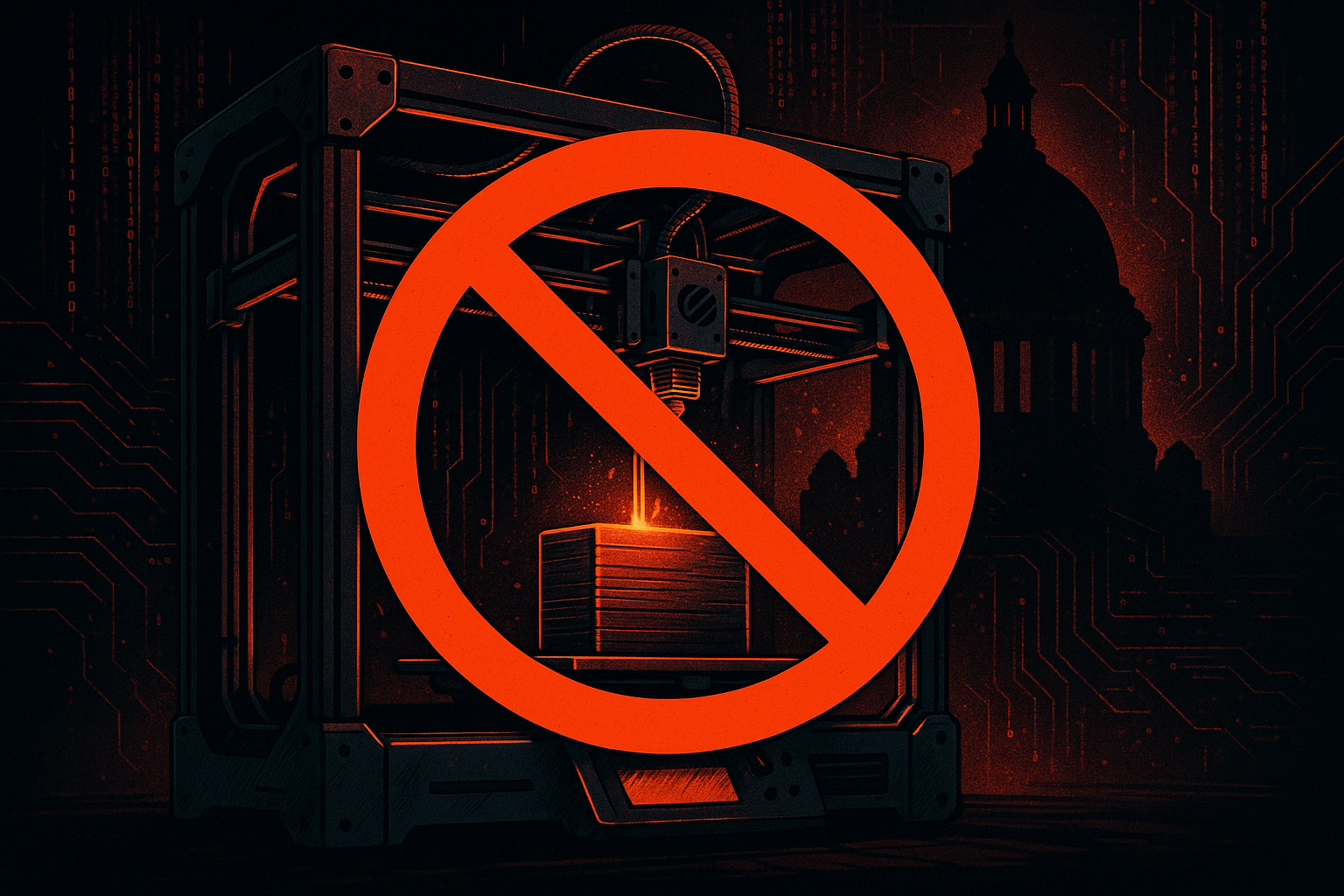
If you own a 3D printer in Washington State, you may soon be a criminal — even if you’ve never printed anything remotely resembling a weapon.
On March 11, 2026, the Washington State Legislature passed HB 2320 with a 58-38 vote in the House and concurrence in the Senate. The bill was delivered to Governor Bob Ferguson on March 12, and gun safety advocates expect him to sign it without hesitation.
The bill targets “ghost guns” — unserialized, untraceable firearms that can be manufactured at home. But its language reaches far beyond firearms, creating a legal framework that could criminalize the possession of certain digital files, restrict the sale of general-purpose manufacturing equipment, and fundamentally reshape what you’re allowed to do with the 3D printer sitting in your home workshop.
For the smart home community — makers, tinkerers, and IoT enthusiasts who rely on 3D printing for everything from custom enclosures to replacement parts — this bill sets a precedent that should concern everyone.
What HB 2320 Actually Does
At its core, the bill strengthens Washington’s existing ghost gun statute by specifically targeting digital manufacturing technology. Here’s what it does:
Criminalizes “Digital Firearm Manufacturing Code”
The bill defines “digital firearm manufacturing code” as any digital instructions in the form of computer-aided design files or other code or instructions stored and displayed in electronic format as a digital model that may be used to program a three-dimensional printer or a computer numerical control (CNC) milling machine to manufacture or produce a firearm, frame or receiver, unfinished frame or receiver, magazine, or unlawful firearm part.
Simply possessing these files could constitute a crime under the bill’s “rebuttable presumption” framework. That means if law enforcement finds certain CAD files on your computer, the burden shifts to you to prove you weren’t planning to manufacture a weapon.
Bans 3D-Printed Firearm Manufacturing
The bill makes it illegal to manufacture, cause to be manufactured, assemble, or cause to be assembled an untraceable firearm using a 3D printer, CNC milling machine, or “other means.” That last phrase — “or other means” — is a catch-all that critics argue could sweep in virtually any manufacturing method.
Creates a Precedent for Equipment Regulation
While the final version of HB 2320 removed an earlier provision that would have banned the sale of 3D printers and CNC machines “marketed primarily for firearm manufacture,” the bill’s framework creates the legislative scaffolding for future equipment restrictions. The original version’s language around restricting the sale and transfer of manufacturing equipment was only stripped during committee amendments — it can easily be reintroduced.
Why Smart Home Makers Should Pay Attention
You might be thinking: I print sensor enclosures and cable management clips, not firearms. How does this affect me?
Here’s how.
The “Rebuttable Presumption” Problem
Under HB 2320, possessing digital firearm manufacturing code creates a rebuttable presumption of criminal intent. But here’s the problem with digital files: you might not even know you have them.
Open-source CAD repositories like Thingiverse, Printables, and GitHub host millions of design files. If you’ve downloaded a bulk collection of models, participated in open-source hardware projects, or even browsed certain maker forums, files that could be classified as “digital firearm manufacturing code” might exist on your hard drive, in your cloud storage, or cached in your browser.
As Jeremy Hanson, founder of Seattle Maker’s Space, told FOX 13 Seattle: “Outlawing code in general is a restriction on first amendment rights and has privacy concerns for individuals.”
The Vague Definition of “Firearm Part”
The bill regulates the manufacturing of “frames or receivers, unfinished frames or receivers, magazines, or unlawful firearm parts.” But many of these components share geometric properties with completely legal, non-firearm objects.
A spring-loaded mechanism for a custom smart home device. A cylindrical housing for a sensor array. A mounting bracket with specific tolerances. At what point does a 3D-printable design cross the line from “maker project” to “firearm component”?
As critics have noted, “Guns are being made of things that are used in everything from robotics to appliances, machines and household items and include parts such as pins, springs, rods, dowels, and hinges. It’s akin to outlawing geometry.”
The Software and Firmware Implications
This is where things get particularly concerning for the IoT and smart home community. The bill targets “digital instructions” that can be used to “program” a 3D printer or CNC machine. Modern 3D printers are networked devices running sophisticated firmware — they’re IoT devices themselves.
If the regulatory framework expands (as precedent-setting legislation tends to do), we could see:
- Mandatory content filtering built into 3D printer firmware that scans G-code before execution
- Print logging requirements that record every object manufactured on home devices
- Network monitoring obligations for internet-connected printers
- Licensing requirements for ownership of manufacturing-capable devices
This isn’t speculation — it’s the logical trajectory of regulating digital manufacturing at the code level.
The Open Source Threat
Adafruit, one of the largest open-source hardware companies in the world, sounded the alarm early, calling the bill “bad for STEM, bad for business, and bad for open source 3D printing.”
The smart home ecosystem runs on open source. From Home Assistant to ESPHome, from custom PCB designs to 3D-printable enclosures — the maker community’s greatest strength is the free exchange of digital designs and code. HB 2320’s approach of criminalizing the possession of certain digital files is fundamentally at odds with this ethos.
The Constitutional Collision Course
HB 2320 sits at the intersection of three constitutional amendments, and legal challenges are all but inevitable:
First Amendment: The NRA’s Aoibheann Cline testified that “Digital firearm codes are speech protected by the First Amendment. This sets forth a dangerous precedent for enforcing and policing of the internet.” Courts have consistently held that code is speech — from the Bernstein v. U.S. Department of Justice encryption case to more recent decisions around 3D printing files.
Second Amendment: The bill effectively prohibits the private manufacture of firearms, a practice that has been legal in the United States since before the nation’s founding. The Supreme Court has not directly addressed whether the right to bear arms includes the right to manufacture them, but lower courts have been grappling with this question.
Fifth Amendment: The “rebuttable presumption” clause essentially shifts the burden of proof from the state to the accused. If you possess certain files, you must prove your innocence — a framework that critics argue violates due process protections.
The Precedent Problem
This is what should really concern you, regardless of where you stand on gun control.
As the Twitter user @loyalmoses noted when sharing the bill’s passage: “Once this is law, it sets precedent for similar bills in other states. THIS makes the slope very slippery.”
He’s right. Washington is often a legislative bellwether. The state’s aggressive approach to regulating digital manufacturing could inspire copycat legislation across the country. Everytown for Gun Safety explicitly called Washington’s passage a model, saying the state is “showing the rest of the country what it looks like to boldly respond to emerging threats.”
If the framework of criminalizing digital files and regulating general-purpose manufacturing equipment takes hold nationally, the implications extend far beyond firearms:
- Drug manufacturing: Could possessing chemistry equipment and certain molecular models become a criminal presumption?
- Drone regulation: Could CAD files for drone components be classified as restricted digital manufacturing code?
- Cybersecurity tools: Could possession of certain software tools create a presumption of criminal hacking intent? (This one is already happening in other contexts.)
What You Can Do
If you’re a Washington State resident who uses 3D printers, CNC machines, or any digital manufacturing technology:
-
Audit your file libraries. Know what’s on your drives. If you’ve downloaded bulk CAD collections, review them for files that could be classified as firearm-related.
-
Document your legitimate use. Keep records of your projects, purchases, and the intended purpose of your manufacturing equipment. Under a rebuttable presumption framework, documentation is your defense.
-
Secure your digital files. Encrypt your design files and maintain access logs. If your 3D printer is network-connected (and most modern ones are), ensure it’s properly secured and segmented on your home network.
-
Engage with the legislative process. Contact Governor Ferguson’s office. Reach out to your state representatives. Join organizations like the Electronic Frontier Foundation, Adafruit, or your local maker space to stay informed about digital rights legislation.
-
Watch for similar bills in your state. If you’re outside Washington, this fight is coming to you next. Monitor state legislature tracking sites like BillTrack50 for similar proposals.
The Bottom Line
HB 2320 was written to address a real public safety concern — the proliferation of untraceable firearms manufactured with increasingly accessible technology. Nobody disputes that ghost guns used in crimes are a serious problem.
But the bill’s approach of criminalizing digital files, creating presumptions of guilt around code possession, and building regulatory frameworks around general-purpose manufacturing equipment doesn’t just target criminals. It creates a legal minefield for every maker, tinkerer, and smart home enthusiast who uses a 3D printer to build custom parts for their projects.
The smart home community has always lived at the intersection of technology and regulation. From Wi-Fi spectrum allocation to IoT security standards to data privacy laws, we’re accustomed to navigating the tension between innovation and oversight.
But HB 2320 represents something new: the criminalization of manufacturing capability itself. Not the act of building a weapon, but the potential to do so — as determined by the digital files on your computer and the equipment in your workshop.
That’s a precedent that should keep every maker up at night.
The bill was delivered to Governor Ferguson on March 12, 2026. He has until March 28 to sign it into law, veto it, or allow it to become law without his signature. Gun safety advocates expect him to sign. Track the bill’s status at app.leg.wa.gov.